Connected Vehicles: Driving the Future of Transportation
Posted On October 5, 2026
Picture this: You are driving down a rain-slicked highway during evening rush hour. Up ahead, around a blind curve two hundred meters away, a delivery truck slams on its brakes to avoid a stalled car. Before your eyes can even register the hazard through the torrential downpour, a flashing red warning icon lights up your windshield display, and your car gently begins pre-charging its brakes—stopping you safely with yards to spare.
Over my ten-plus years testing emerging hardware, IoT architecture, and automotive systems, I have had the privilege of inspecting automotive telemetry setups right from the test track floor. Early in my career, “car tech” meant little more than Bluetooth audio streaming and clunky built-in GPS maps.
Today, that landscape has transformed completely. Modern connected vehicles are no longer just mechanical transport machines with added screens; they are sophisticated, mobile edge-computing datacenters on wheels.
Here is a deep dive into how connected automotive technology actually works, why it is revolutionizing road safety, and what you need to know as we step into a hyper-connected transport era in 2026.
How Connected Vehicles Talk: Understanding V2X Communication
To understand how connected vehicles interact with the world around them, think of a traditional automobile as a isolated island. It relies purely on the driver’s eyes, ears, and basic onboard sensors to navigate hazards.
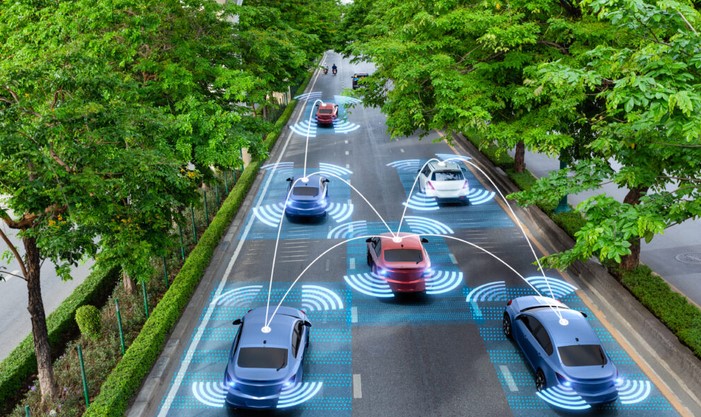
In contrast, a connected vehicle acts like a member of a coordinated orchestra. Through Vehicle-to-Everything (V2X) technology, your car constantly broadcasts and receives real-time telemetry data across multiple operational layers:
┌───────────────────────────────────────────────────────────┐
│               THE V2X COMMUNICATION ARCHITECTURE          │
├──────────────────────────┬────────────────────────────────┤
│ V2V (Vehicle-to-Vehicle) │ Collision Avoidance & Platooning│
│ V2I (Vehicle-to-Infras.) │ Traffic Lights & Toll Systems  │
│ V2P (Vehicle-to-Pedest.) │ Crosswalk & Cyclist Detection  │
│ V2C (Vehicle-to-Cloud)   │ OTA Updates & Telemetry Maps   │
└──────────────────────────┴────────────────────────────────┘
-
V2V (Vehicle-to-Vehicle): Cars share speed, acceleration vectors, and braking status with nearby traffic in milliseconds to prevent multi-car pileups.
-
V2I (Vehicle-to-Infrastructure): Communicates with smart traffic lights, toll gantries, and road sensors to optimize traffic signal timing and warn of upcoming construction zones.
-
V2P (Vehicle-to-Pedestrian): Interacts with smartphones and smart wearables carried by pedestrians or cyclists to alert drivers to hidden crosswalk hazards.
-
V2C (Vehicle-to-Cloud): Streams high-volume telemetry data to central enterprise cloud servers for predictive maintenance and live traffic mapping.
The Tech Under the Hood: C-V2X vs. Dedicated Short-Range
Behind every seamless dashboard alert lies a high-speed wireless protocol working around the clock. The current industry standard is Cellular Vehicle-to-Everything (C-V2X), powered by ultra-low latency 5G NR (New Radio) networks.
Unlike traditional consumer cellular connections that suffer from network buffering, C-V2X incorporates direct side-link communication mode. This allows two cars to communicate directly with each other even in remote rural areas without relying on a cell tower.
Technical Comparison: Traditional Cars vs. Connected Vehicles
| System Feature | Traditional Non-Connected Car | Modern Connected Vehicle |
| Primary Safety Layer | Mechanical seatbelts, airbags, driver reaction | Predictive V2X collision prevention & automated braking |
| Diagnostics & Service | Physical OBD-II scanner at auto shop | Real-time predictive cloud diagnostics |
| Software Management | Dealer visits for firmware flashing | Over-the-Air (OTA) background updates |
| Navigation Data | Static offline maps | Dynamic high-definition (HD) real-time traffic maps |
| Data Processing | Isolated internal ECU units | Edge-computing AI modules with cloud synchronization |
Key Benefits: Safety, Efficiency, and Predictive Maintenance
The rapid adoption of connected vehicles yields benefits far beyond simple smartphone integration:
1. Drastic Reduction in Traffic Accidents
According to global transportation safety statistics, over 80% of multi-vehicle crashes involve driver error or environmental line-of-sight obstruction. By giving vehicles the ability to “see” around physical obstacles, V2X technology eliminates common blind spots.
2. Reduced Carbon Footprint and Fuel Efficiency
By synchronizing with smart traffic signals, connected cars calculate optimal travel speeds to hit green lights continuously—a process known as Green Light Optimal Speed Advisory (GLOSA). This reduces idling time, cuts fuel consumption, and lowers vehicle emissions in urban areas.
3. Predictive Diagnostics over Reactive Repairs
During my field audits of connected fleet vehicles, one stand-out feature is cloud-based telemetry monitoring. Instead of waiting for a engine warning light to turn on after a breakdown, built-in algorithms detect subtle vibration anomalies in water pumps or battery degradation weeks before failure occurs.
Expert Advice: Pro-Tips & Hidden Caveats
If you are planning to buy a modern connected car or manage a business fleet, keep these practical considerations in mind:
💡 Pro Tip: Verify Over-the-Air (OTA) Support Architecture
Before purchasing a new vehicle, ensure the manufacturer supports full-vehicle Over-the-Air (OTA) software updates. Legacy platforms only update the infotainment screen, whereas advanced software-defined vehicle (SDV) architectures allow distant updates to improve battery management efficiency, motor torque, and safety features without visiting a service shop.
⚠️ Hidden Caveat: Data Privacy & Cybersecurity Risks
Because connected vehicles continuously broadcast location coordinates, driving habits, and biometric data to cloud servers, they create potential privacy concerns and cybersecurity attack vectors. Always inspect your vehicle’s data sharing and telemetry settings, opt out of third-party broker data sharing, and ensure your home garage Wi-Fi network uses robust WPA3 encryption for home OTA syncs.
Stepping Into the Era of Software-Defined Mobility
The transition toward hyper-connected transport is transforming our daily commutes into safer, smoother, and far more predictable journeys.
As connected vehicles integrate deeper into smart city infrastructure, we move closer to a zero-collision future where cars act not as isolated metal boxes, but as intelligent partners on the open road.
Join the Conversation
Would you trust a connected vehicle to automatically adjust your speed and route based on live road-network telemetry, or do you prefer full manual driving control? Drop your thoughts, experiences, or questions in the comments below! Let’s discuss the future of transportation together.
About The Author
